Common Smoke and Fire Curtain Installation Mistakes That Compromise Life Safety
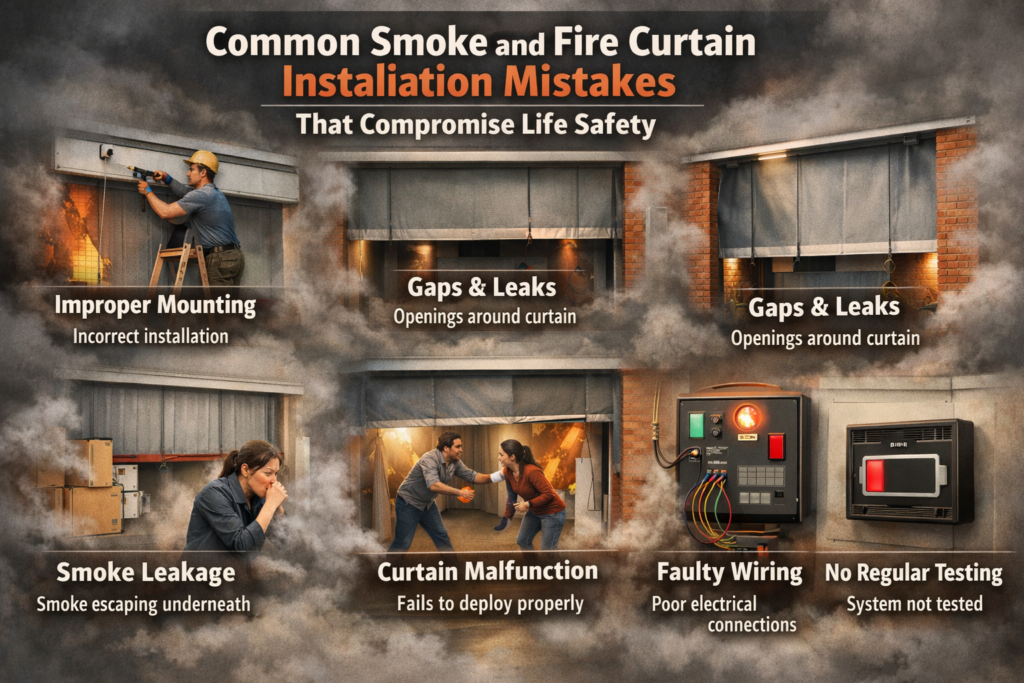
Even when the correct smoke or fire curtain system is specified, poor installation can severely reduce its effectiveness. Many failures observed during testing, commissioning, or real fire events are not due to product limitations, but due to installation errors made on site.
This article highlights the most common smoke and fire curtain installation mistakes, explains why they occur, and outlines their impact on life safety and regulatory compliance.
Introduction
Smoke and fire curtains are precision life-safety systems that must operate exactly as designed during an emergency. Unlike decorative or non-critical building elements, even minor installation deviations can prevent proper deployment or system performance.
Understanding common installation errors helps designers, contractors, and facility teams avoid costly corrections and ensures reliable operation during a fire event.
Incorrect Curtain Positioning and Coverage
One of the most frequent mistakes is incorrect positioning of smoke or fire curtains. Curtains installed too high, too low, or offset from the designed line can fail to form effective smoke reservoirs or fire compartments.
Gaps between the curtain and adjacent walls, beams, or floors allow smoke or fire to bypass the system, rendering it ineffective despite correct specification.
Lack of Coordination with Other Building Elements
Smoke and fire curtains often conflict with lighting, sprinklers, HVAC diffusers, signage, or architectural features. Poor coordination during installation can obstruct curtain deployment or reduce its effective drop height.
In some cases, site teams modify curtain locations to suit aesthetics or services routing without consulting the fire strategy, leading to non-compliance and authority rejection.
Improper Fixing and Support Structures
Curtains rely on correctly designed and installed support structures. Fixing curtain headboxes to non-structural elements, lightweight ceilings, or unapproved steelwork can result in movement, misalignment, or failure during deployment.
Support structures must be capable of withstanding operational loads, fire exposure, and dynamic forces during curtain deployment.
Electrical and Control Integration Errors
Incorrect wiring, poor termination, or lack of integration with fire alarm and control systems is another critical issue. Curtains that do not receive the correct activation signal may fail to deploy during a fire.
Equally problematic are systems that deploy unintentionally due to incorrect programming or lack of fail-safe logic, causing operational disruptions and loss of confidence in the system.
Failure to Conduct Proper Testing and Commissioning
Inadequate testing is one of the most dangerous installation mistakes. Curtains must be tested for full deployment, alignment, response time, and coordination with other fire safety systems.
Skipping witnessed testing or relying solely on visual inspection often leads to failures being discovered too late, during authority inspections or real emergency situations.
Ignoring Maintenance and Access Requirements
Curtains installed without sufficient access for inspection and maintenance quickly degrade in performance. Obstructed headboxes, inaccessible control panels, or undocumented systems increase the risk of failure over time.
Maintenance considerations must be addressed during installation, not after handover.
Conclusion
Smoke and fire curtain systems are only as effective as their installation. Even high-quality, compliant products can fail if installed incorrectly or without proper coordination.
Avoiding common installation mistakes ensures reliable operation, smoother approvals, and most importantly, effective life safety performance when it matters most.
About Author
Eng. H. Rehman
Smoke and Fire Curtains Experts (SFC Experts)
WhatsApp: +966 53 923 0759 | +971 52 662 0076
Website: www.sfcexperts.com
Correct installation is as critical as correct specification. Contact us for specialist installation, testing, commissioning, and compliance support for smoke and fire curtain systems.