Fire Curtains: Passive Fire Protection and Compartmentation
A Practical Guide for Modern Buildings
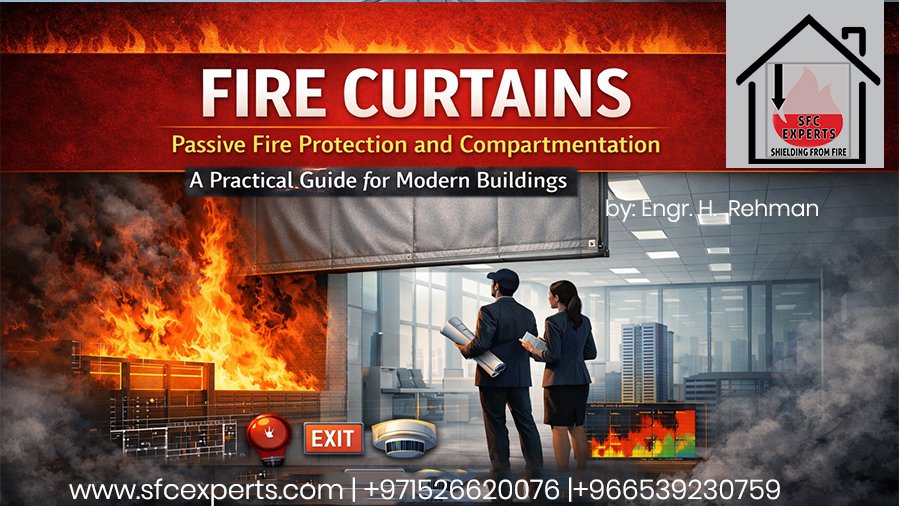
Fire Curtains are a key element of passive fire protection in modern buildings, particularly where open architectural designs limit the use of traditional fire walls and fire-rated doors. This article explains how fire curtains work, their role in fire compartmentation, and why they are increasingly specified in high-rise, commercial, and complex developments to meet life-safety and regulatory requirements.
Introduction
Modern architecture increasingly favors open spaces, atriums, interconnected floors, and large unobstructed openings. While visually appealing and functional, these designs challenge conventional fire compartmentation methods.
Fire Curtains provide a flexible and effective solution by delivering fire separation only when required, without permanently altering architectural layouts. They are now widely used as part of engineered fire strategies in buildings where fixed fire barriers are impractical or undesirable.
What Are Fire Curtains?
Fire Curtains are automatically deployed barriers manufactured from fire-resistant fabrics and tested to withstand fire exposure for a defined period. They remain concealed during normal operation and descend automatically during a fire event to create temporary fire compartments.
Depending on the system design, fire curtains can provide:
- Fire resistance for a specified duration
- Compartmentation between fire zones
- Protection of openings that cannot be closed using rigid fire doors or shutters
Fire curtains are considered part of the building’s passive fire protection system, meaning they function without relying on fire suppression.
How Fire Curtains Work
Fire curtains are typically connected to the building’s fire alarm or detection system. Upon activation, the curtain deploys under gravity fail-safe operation or controlled motor descent.
Once deployed, the curtain forms a fire-resistant barrier that:
- Restricts fire spread between compartments
- Limits heat transfer through large openings
- Protects adjacent spaces and escape routes
Fire curtains are designed to operate safely during power failure and are tested to ensure reliable deployment under fire conditions.
Role of Fire Curtains in Fire Compartmentation
Fire compartmentation is a fundamental fire safety principle intended to contain fire within a defined area for a specified time. This containment:
- Slows fire spread
- Reduces structural damage
- Protects escape routes
- Provides time for evacuation and firefighting
Fire curtains allow designers to achieve compartmentation where fixed fire walls are not feasible. They are commonly used to protect atrium edges, escalators, lift lobbies, and large openings between fire zones.
Fire Curtains vs Traditional Fire Barriers
Unlike permanent fire walls or fire doors, fire curtains:
- Remain hidden during normal building operation
- Deploy only during a fire event
- Preserve architectural openness and aesthetics
- Offer flexibility in design and space planning
This makes them particularly suitable for modern commercial and mixed-use developments.
Typical Applications of Fire Curtains
Fire curtains are widely used in:
- Atriums and large voids
- Escalators and open staircases
- Lift lobbies and elevator shafts
- Shopping malls and retail environments
- Hotels, high-rise buildings, and mixed-use projects
- Airports and transport terminals
In many cases, fire curtains are combined with smoke curtains and smoke control systems to provide a complete fire and life-safety strategy.
Integration with Fire Safety Systems
Fire curtains are not standalone products. They are integrated with:
- Fire alarm and detection systems
- Emergency power supplies
- Control panels and monitoring systems
- Building Management Systems where required
This integration ensures coordinated operation during fire events and allows system status monitoring and fault detection.
Codes, Standards, and Compliance
Fire curtains must be designed, tested, and installed in accordance with applicable standards and authority requirements. These typically include:
- BS and EN fire resistance standards
- NFPA guidelines where applicable
- UL or equivalent fire testing certifications
- Local Civil Defense and Authority Having Jurisdiction requirements
Early involvement of fire consultants and specialist contractors is essential to ensure that fire curtains are accepted as part of the approved fire strategy.
Importance of Early Design Coordination
Fire curtain locations, ratings, and deployment logic should be defined during the early design stages. Late introduction often results in:
- Design conflicts
- Approval delays
- Increased project costs
Early coordination ensures that fire curtains align with architectural intent, structural constraints, and fire engineering calculations.
Conclusion
Fire Curtains are a vital component of passive fire protection in modern buildings. By enabling effective fire compartmentation without compromising architectural design, they play a critical role in protecting lives, property, and evacuation routes.
When properly specified, integrated, and maintained, fire curtains provide a reliable and compliant solution for managing fire spread in complex building environments.
Author
Eng. H. Rehman
Smoke and Fire Curtains Experts
WhatsApp: +966 53 923 0759 | +971 52 662 0076
Website: www.sfcexperts.com
If you are planning a new project or upgrading an existing facility, early integration of fire curtains can significantly improve safety, compliance, and design flexibility. Contact us today for technical consultation, system design support, and compliant installation solutions.
Proudly powered by WordPress