Testing, Commissioning, and Authority Approval of Smoke and Fire Curtains
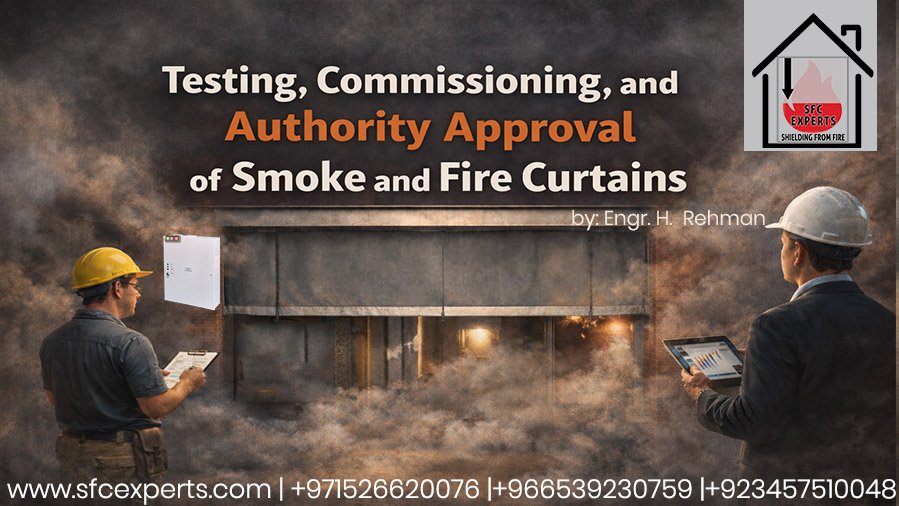
Testing and commissioning are the final and most critical stages in delivering a compliant smoke or fire curtain system. Even correctly designed and well-installed systems can fail to achieve authority approval if testing procedures are incomplete, poorly coordinated, or not aligned with the approved fire strategy.
This article explains how smoke and fire curtains are tested, what authorities expect during inspections, and how proper commissioning supports formal approval and long-term system reliability.
Introduction
Smoke and fire curtains are active life-safety systems that must perform reliably during an emergency. Authorities Having Jurisdiction do not rely on product certification alone; they require on-site verification that the installed system operates exactly as approved within the building.
Testing and commissioning form the basis for authority approval, confirming that smoke and fire curtains function correctly, integrate with other fire safety systems, and comply with approved design documentation.
Purpose of Testing and Commissioning
The primary purpose of testing is to confirm that smoke and fire curtains deploy correctly, within the required time, and without obstruction. Commissioning ensures that all system components operate together as a coordinated life-safety solution.
This process verifies mechanical operation, electrical integration, control logic, fail-safe behavior, and interaction with smoke extraction, pressurization, and fire alarm systems as defined in the fire strategy.
Pre-Testing Requirements
Before authority inspections, all installations must be complete and free of temporary supports or obstructions. Curtain locations, drop heights, and fixing details must match approved shop drawings and fire engineering submissions.
Power supplies, control panels, and interfaces with the fire alarm system must be energized, labeled, and accessible for inspection. Any deviations from approved documents should be resolved before formal testing begins.
Functional Testing of Smoke Curtains
Smoke curtain testing typically includes:
• Automatic deployment upon fire alarm activation
• Correct drop height and alignment
• Smooth and uninterrupted curtain descent
• Coordination with smoke extraction fans
• Fail-safe operation during power loss
Authorities often require repeated deployment tests to confirm reliability and consistency before approval is granted.
Functional Testing of Fire Curtains
Fire curtain testing focuses on:
• Full deployment to floor level
• Integrity of side guides and end seals
• Correct response to fire alarm signals
• Hold-open and gravity-fail functions where applicable
Fire curtains must demonstrate that they form an effective fire compartment boundary in accordance with their fire rating and approved design intent.
System Integration and Cause-and-Effect Verification
Verification of the cause-and-effect matrix is a key requirement for authority approval. Inspectors expect clear confirmation that curtain deployment aligns with the approved fire strategy and does not conflict with other fire safety systems.
This includes coordination with:
• Fire alarm and detection systems
• Smoke control panels
• Mechanical smoke extraction systems
• Emergency power supplies
• Building Management Systems where applicable
Incorrect sequencing or undocumented logic changes are common reasons for approval delays.
Documentation and Authority-Witnessed Testing
Complete documentation is essential for formal approval. This typically includes:
• Approved shop drawings and fire calculations
• Product certifications and compliance reports
• Site testing and commissioning records
• Cause-and-effect matrices
• Operation and maintenance manuals
Many authorities require authority-witnessed testing, where system operation is demonstrated in their presence before final approval or completion certification is issued.
Post-Approval Testing and Ongoing Compliance
Authority approval does not eliminate the need for ongoing testing and maintenance. Smoke and fire curtains must be inspected and tested periodically to ensure continued compliance and operational readiness.
Curtains that are not maintained or periodically tested may fail due to mechanical wear, control faults, or unauthorized site modifications.
Conclusion
Testing and commissioning are essential to achieving authority approval of smoke and fire curtain systems. Proper planning, coordination, and documentation ensure reliable operation, regulatory compliance, and confidence in system performance.
A properly approved and commissioned system protects lives, supports evacuation, and strengthens the overall fire safety strategy of the building.
About Author
Eng. H. Rehman
Smoke and Fire Curtains Experts (SFC Experts)
WhatsApp: +966 53 923 0759 | +971 52 662 0076
Website: www.sfcexperts.com
Professional testing and commissioning are critical for authority approval. Contact us for compliant testing, commissioning, and approval support for smoke and fire curtain systems.